
€799.00*
previously €799.00*Delivery time approx. 30 - 34 business days
Can't find anything suitable? Configure your letterbox individually!
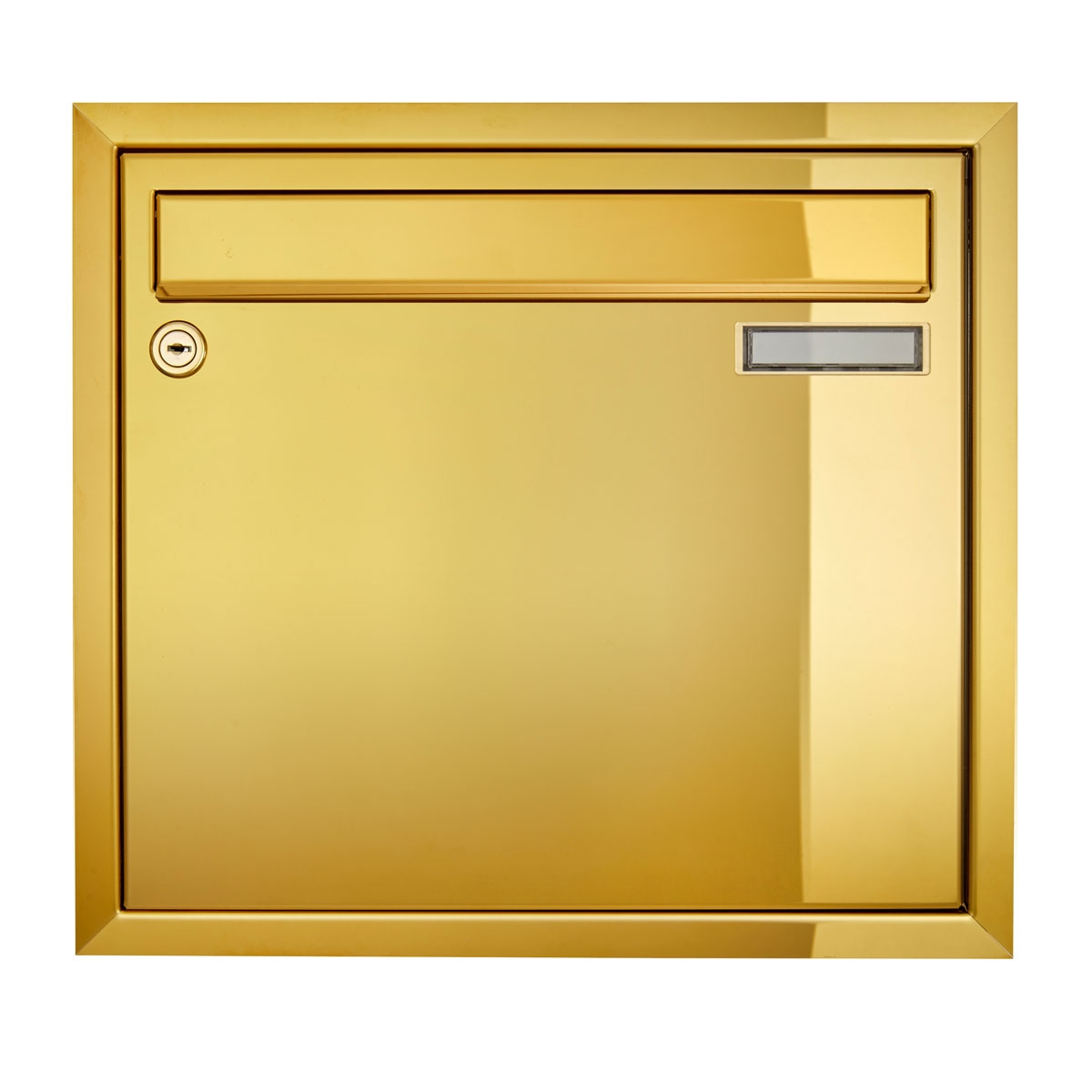
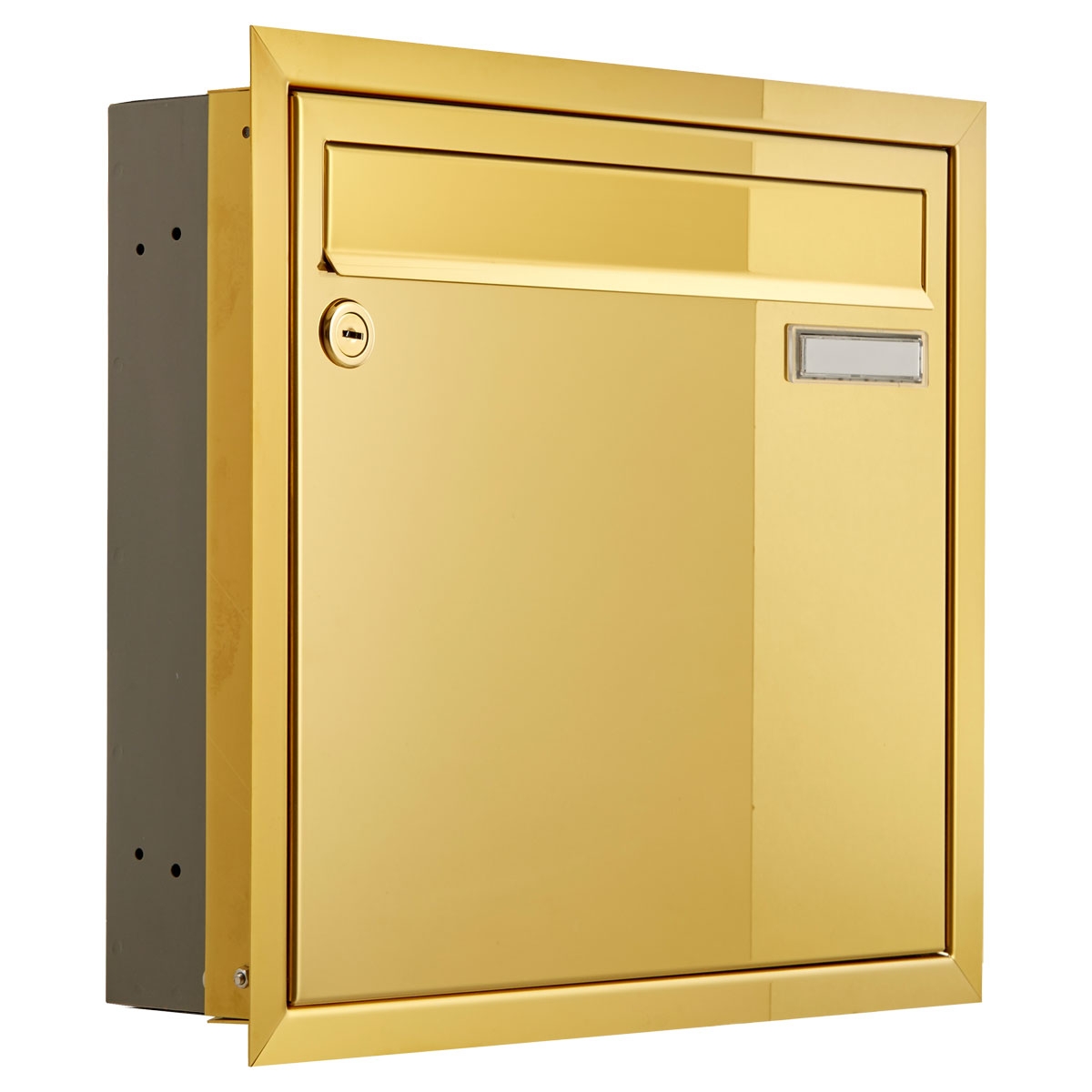
Flush-mounted letter box CLASSIC 534C - Titanium brass similar to gold - 1 party
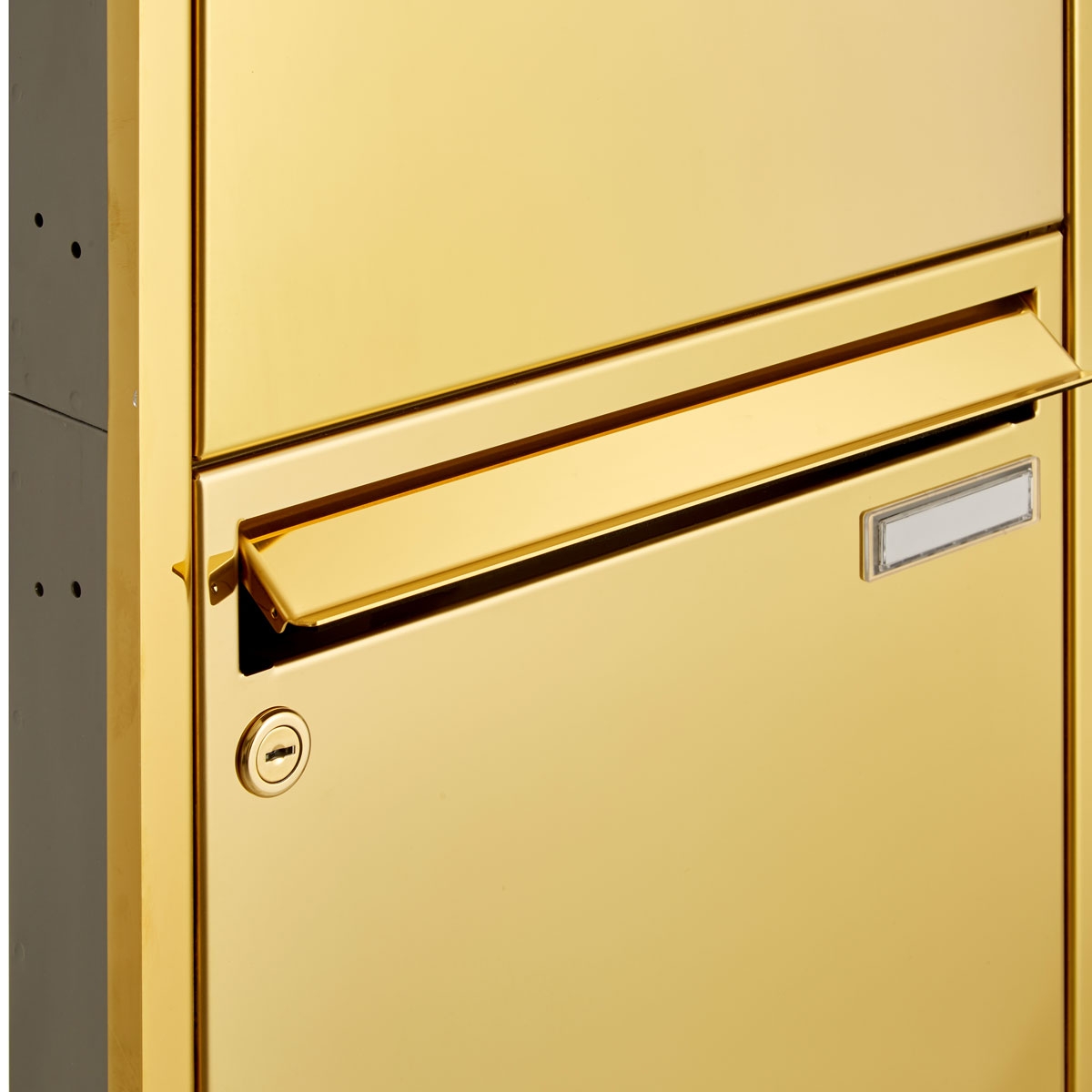
This elegant flush-mounted letterbox has a titanium brass surface similar to gold. The dimensions are ideal for daily mail volumes. A rain drainage edge for optimum water protection, a damped throw-in flap, the solid interchangeable nameplate, a practical post holder and the very robust lock ensure convenience.
- Flush-mounted letterbox with polished stainless steel PVD "titanium brass" front.
- Inner housing made of galvanised steel, grey powder-coated.
- German quality production "Made in Germany".
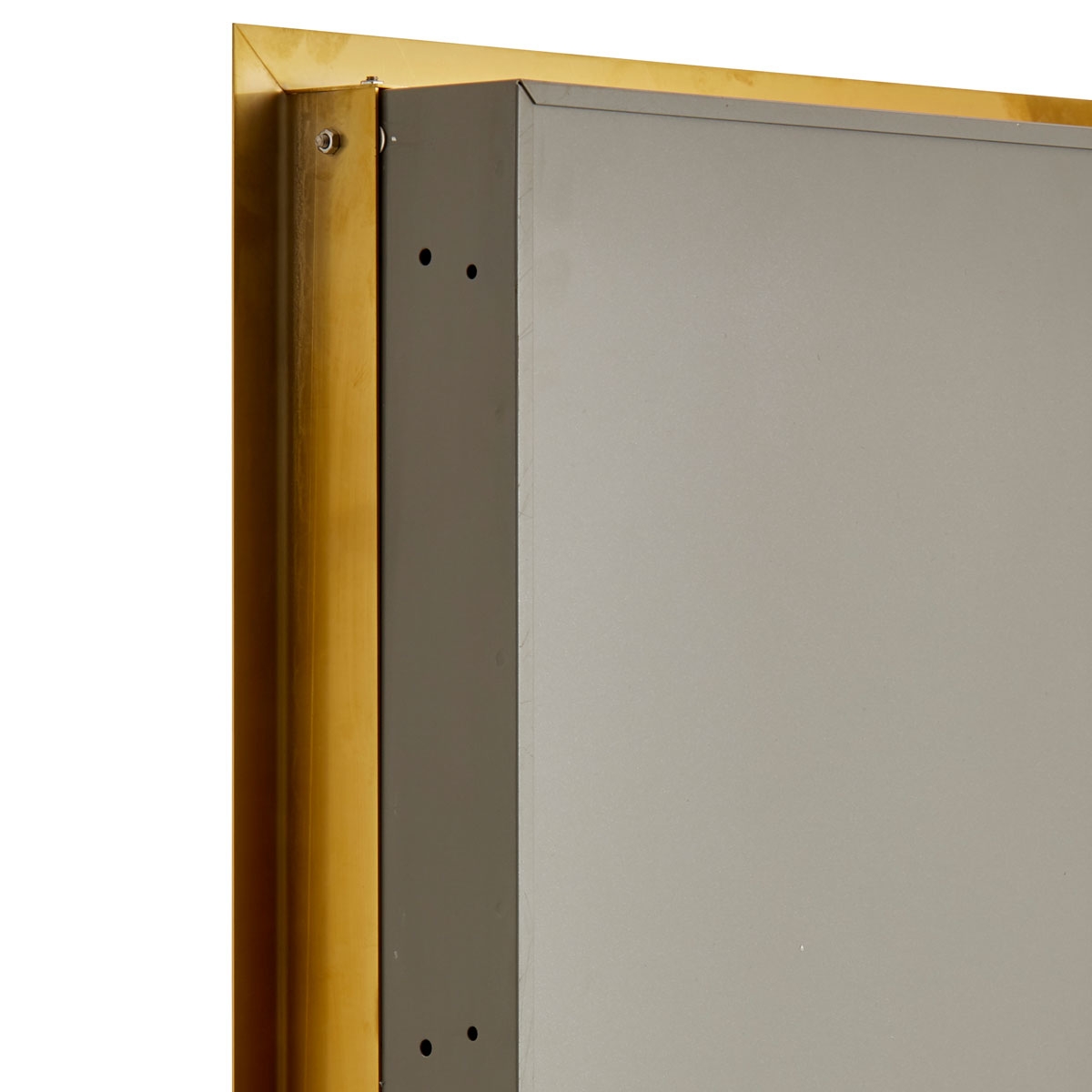
- Plaster cover frame 20 mm all round made of polished stainless steel PVD "Titanium brass".
- The letterbox complies with DIN/EN 13724. Insertion size (3.3 cm x 33.6 cm) for C4 landscape, large letters also fit in here without creasing.
- Insertion flap with flap damper for very quiet mail insertion.
- The removal door can be opened from left to right.
- Incl. 2 keys with key number, interchangeable name plate under the flap and post holder.
- The labelling on the name plates can be changed as required.
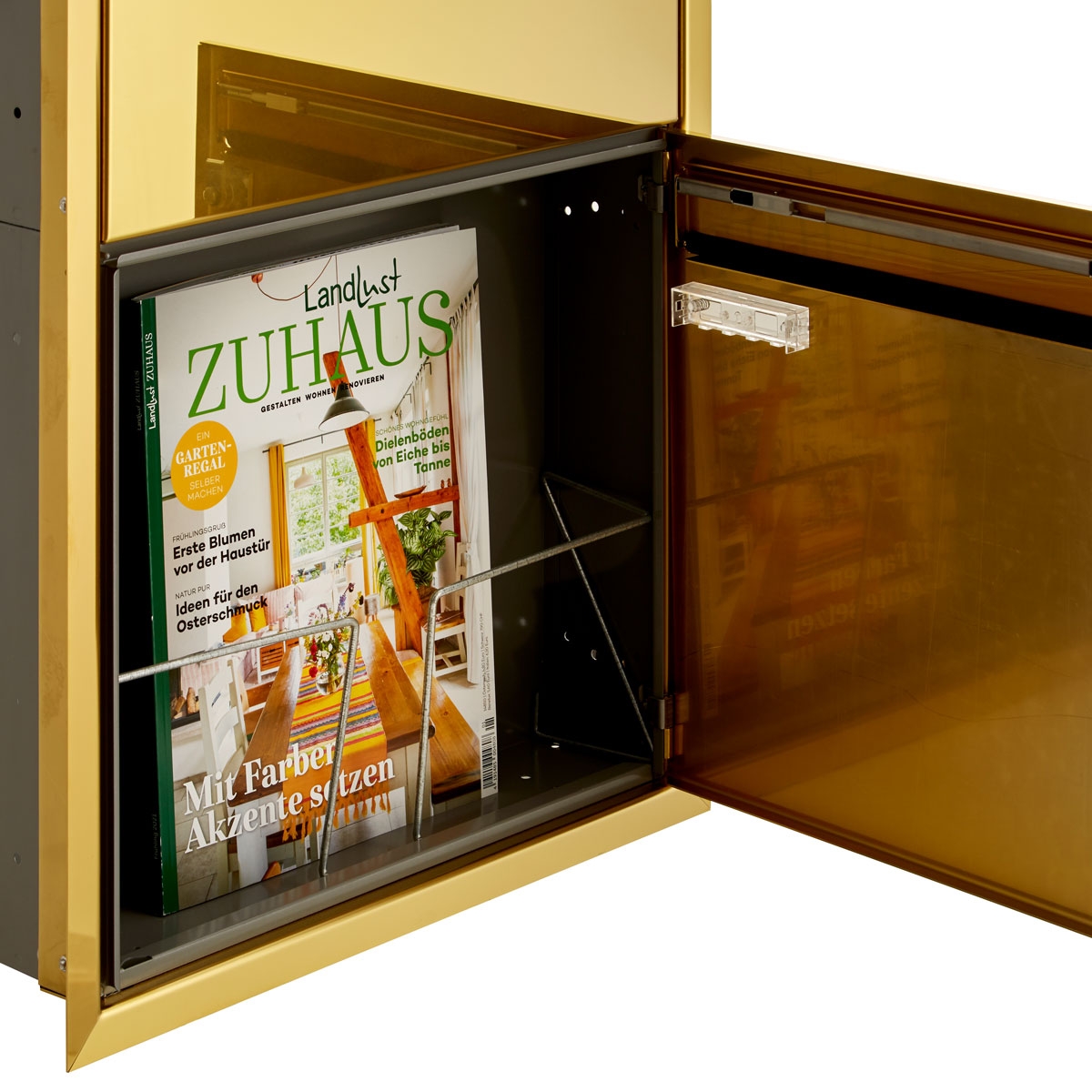
- The post holder prevents the post from falling out when the door is open.
- Installation dimensions or cut-out dimensions: W 370 mm x H 330 mm plus 15 mm all round.
- For flush mounting with surface-mounted plaster frame.
| Material: | Stainless steel V2A 1.4301, Steel, galvanised |
|---|---|
| Number of boxes: | with 1 letterbox |
| Removal of mail: | On the front |
Briefkasten Manufaktur Lippe GmbH
Werler Str. 60
32105 Bad Salzuflen
Deutschland
info@briefkasten-manufaktur.de
| Height of single box in mm: | 330,0 |
|---|---|
| Width of single box in mm: | 370,0 |
| Capacity in litres: | 12 |
| Height of letterbox slot in mm: | 33,0 |
| Width of letter slot in mm: | 336,0 |
| Height of letterbox in mm: | 370,0 |
| Width of letterbox system in mm: | 410,0 |
| Depth in mm: | 100,0 |
| Weight in kg: | 6 |
| Delivery condition: | Supplied fully assembled |
| Shipping information: | Depending on the order volume, delivery will be by parcel post or bulky goods. Partial deliveries are possible for dismountable products (e.g. stand mailboxes can be shipped separately). |
Frequently asked questions about letterbox systems
We recommend concrete foundations (B25) for free-standing systems, with the dimensions per frame side being 450 x 450 mm. For smaller systems, a continuous foundation with the following dimensions is required: system width + 450 x 450 mm. The foundation should be enlarged depending on the ground conditions. The depth of the foundation should be at least 700 mm, depending on the frost line in the soil. Before excavation, it is advisable to obtain a plan of the planned installation site from the relevant authority so that pipes, electrical cables, etc. are not damaged. Please ensure that the cables are pulled before concreting.
If the system is set in a concrete foundation, the depth of the embedded parts should be 350 mm - 500 mm.
If the system is screwed on to a concrete foundation, you must use bolt anchors (diameter 10 - 12 mm) or equivalent.

We recommend our cover rosettes to finish the screw connection and the transition into the ground.

Without mounting rail:
When mounting letterbox systems on house walls, the relevant recommendations of the dowel manufacturers must be observed depending on the wall condition. Furthermore, care must be taken to ensure that no cold bridges are created by the fixing screws. Use special dowels for wall insulation if necessary. To calculate the total weight of the systems, please refer to our weight specifications in the detailed information.
1. Check
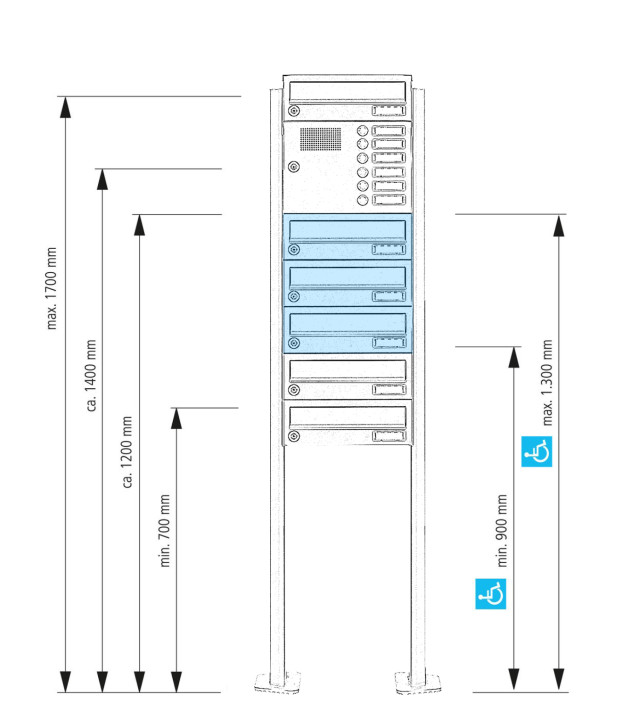
The wall to which the letterbox system is to be attached must be clean and level. Ensure that the wall has the appropriate load-bearing capacity. Depending on its size, a letterbox weighs between 5 and 130 kg. 2. Measure Measure the mounting holes on the back of the system. Transfer these measurements to the wall. Please observe the installation height specified by DIN 13724. The centre line of the lowest mail slot should not be below 700 mm. The centre line of the top mail slot should not be higher than 1,700 mm. Only in exceptional cases (accessibility) are 400 mm as the lower limit and 1,800 mm as the upper limit permissible.
3. Drilling
Drill holes in the wall and insert dowels into the holes. Please note: Hole sizes and dowel types depend on the respective wall conditions and must therefore be determined on site. If in doubt, please seek expert advice on site.
4. Screw together
Open the doors of the boxes in which the mounting holes are located and insert the appropriate screws with the spacers into the wall plugs through these boxes. Screw the system together. This step is best carried out by three people.
With mounting rail:
1. Check
The wall to which the letterbox system is to be attached must be clean and level. Ensure that the wall has the appropriate load-bearing capacity. Depending on its size, a letterbox weighs between 5 and 130 kg.
2. Measure
The holes in the rail below the top edge of the letterbox must be measured in advance. To do this, place the mounting rail on the bracket from behind and measure from the top edge of the letterbox to the holes in the mounting rail. This distance must then be subtracted from the desired top edge measurement of the system.
3. Drilling
Position the supplied wall mounting rail horizontally on the wall. Please observe the mounting height specified by DIN 13724. The centre line of the lowest mail slot should not be below 700 mm. The centre line of the top mail slot should not be higher than 1,700 mm. Only in exceptional cases (accessibility) are 400 mm as the lower limit and 1,800 mm as the upper limit permissible. Now mark the drill holes with a suitable pen. Then drill suitable holes with a suitable drill bit. Finally, attach the wall mounting rail.
3. Screw in place
Now guide the letterbox onto the wall mounting rail and hang it with its mounting rail into the wall mounting rail. Check that the system is level . Now mark the holes for attaching the letterbox to the wall. Remove the letterbox from the wall again and mark the holes in the same way as you did for the wall mounting rail. Now hang the letterbox back onto the wall mounting rail. Open the doors of the boxes containing the mounting holes and insert the appropriate screws into the dowels through these boxes.
Our in-wall systems are equipped with pre-cut cable inlets on all sides, which can be easily removed if necessary. We recommend having the in-wall system installed by a professional, as installing systems in house walls can create thermal bridges if the insulation layer is interrupted during installation.
1. Measure height and width
Measure the exact width and height from the back of the letterbox system. This is important because you need the dimensions without the plaster cover frame. Add a total of approx. 20 mm to these dimensions in both height and width and then draw a rectangle on the wall in which the system is to be installed using these dimensions. Please note the installation height prescribed by DIN EN 13724. The centre line of the lowest insertion opening should not be below 700 mm, and the centre line of the highest insertion opening should not be higher than 1,700 mm. Only in exceptional cases are 400 mm and 1,800 mm permissible as the lower and upper limits.
2. Measure depth
Now measure the overall depth of the letterbox system and add a further 5 to max. 10 mm.
3. Break out niche
Then break out a niche in the wall within the marked rectangle and to the depth of the system.
4. Fit the system
Then carefully fit the system into this niche and, if necessary, correct the niche size.
5. Drill
Bring the system into its final position and mark the drill holes on the wall. Remove the system from the niche and drill the corresponding holes in the back wall of the niche and insert the wall plugs into the holes. Caution: The size of the holes and the type of wall plugs depend on the respective wall properties and must therefore be determined on site. If in doubt, please seek expert advice on site. Tip: The system can also be attached via the side panels.
6. Screw
Now reintroduce the system into the niche, open the doors of the boxes containing the mounting holes and insert the appropriate screws into the dowels through these boxes. Screw the system together. Make sure that the plaster frame completely covers the niche.
To achieve optimal water protection for your post, the system/letterbox should be equipped with the above-mentioned panels or a rain canopy. If possible, the letterbox or letterbox system should be located under a canopy. The post is only protected from water when it is completely placed in the box and the flap is closed. If mail is not fully inserted, moisture and dirt can get into the letterbox. It is therefore necessary to plan sufficiently dimensioned letterboxes for the upcoming demand. We offer extra letterbox depth for increased mail volumes, and we are also happy to manufacture individual special sizes. However, water can still enter the letterbox under certain extreme weather conditions (according to DIN EN 13724 up to 1ccm). This is not a reason for complaint.
Installation direction
In a letterbox system, the post is protected from wind and weather. However, when installing a free-standing system, make sure that the insertion front is not directly facing the weather side, in line with good craftsmanship tradition.
Our complete sets are usually ready for connection! We already program the complete sets at our factory.
However, we always recommend having the electrical installation carried out by an electrician. Please always refer to the operating instructions provided by the manufacturer for wallboxes, intercoms and video systems!
Camera, intercoms or wallbox preparation
We offer preparation of cameras, intercoms and wallboxes from various manufacturers for our systems. The preparation does not include any end devices; it involves the provision of the screw fittings, drill holes and perforations. This means that you can easily mount your end device.
General warnings
Our light and bell modules, as well as our light and bell push buttons, may only be operated at a maximum of 12-24 volts! A transformer with VDE certification must be used! Higher voltages can endanger human life and will void the warranty. Only components with a 100% permissible duty cycle may be connected to the buttons and modules! Failure to observe this warning may result in: - fire hazard - personal injury - destruction of components. Electrical devices may only be installed and assembled by a qualified electrician! Please check whether the power consumption of the standard power supply unit is sufficient for your planned connection (e.g. for bell, intercom, light control as well as cable length and cross-section).
Light/bell push DESIGNER
Light/bell push as a single push-button is used to switch on the lighting in the entrance area and/or a stairwell or to operate a signal generator.
Terminal L1/L2 = LED - illuminated ring 5-24V AC/DC
Terminal C/NO = contactor
Current consumption approx. 40mA
Switching capacity max. 50mA @ 50V DC 1W
Light/bell push button BASIC
Light/bell push buttons as single push buttons are used to switch on the lighting in the entrance area and/or a stairwell or to operate a signal generator.
Terminal +/- = LED illuminated ring 3-24V AC/DC, LED illuminated ring ‘light’ 6-36V 110V/220V AC/DC
Terminal NC/NO = contactor
Current consumption approx. 20mA
Switching capacity max. 5A @ 250V AC
LED light
Please note that our LED lights, if they have not been completely pre-wired and connected by us, may only be operated at 12 volts DC. Other voltages will destroy the LED light and shorten its lifespan.
Attention: Always ensure the correct polarity
If your letterbox is in its original packaging, your keys are in the letterbox (take them out through the insertion slot) or in the enclosed bag (this also contains the assembly aid and other small parts). Every letterbox that leaves our premises is carefully checked and packed. A declaration of care is enclosed by the employee who manufactured your new product. If you still cannot find your key, please feel free to contact us.
DIN EN 13724
When planning a letterbox system, you should always observe the currently valid DIN EN 13724 (also known as the ‘letterbox standard’) so that you or your tenant do not have any problems receiving post.
DIN EN 13724 guarantees you:
• Easy mail delivery without bent letters or personal collection at a post office, e. B. for large DIN C4 envelopes
• Sufficient storage space for higher mail volumes
• No hassle with wet mail
• Best quality through specified and tested materials
• Security against rent reductions through standardised letterboxes
Our products are usually all tested according to this standard and marked accordingly. Only a few do not meet this standard. Find out more
Information about DIN formats that fit into the corresponding letterbox slot is cropping up more and more often. Here is a brief overview of the dimensions of the most common formats:
DIN A5: 148 x 210 mm
DIN A4: 210 x 297 mm
DIN A3: 297 x 420 mm
DIN B5: 176 x 250 mm
DIN B4: 250 x 353 mm
DIN B3: 353 x 500 mm
DIN C5: 162 x 229 mm
DIN C4: 229 x 324 mm
DIN C3: 324 x 458 mm
1.4301 is characterised by its good weldability with electrical processes. Even without heat treatment, the steel is corrosion resistant due to its low carbon content. The carbon content must be below a percentage of 0.08, although values below 0.05% are now common in practice. It can also be polished very well and is flexibly formable. It is approved for temperature stresses of up to 600 °C. Its high-quality appearance is particularly appreciated when polished.
X5CrNi18-10 is a relatively soft, nickel-containing, non-ferromagnetic austenitic steel. To keep the material rust-free and scale-resistant, 1.4301 contains a minimum of 13% chromium.
We now use 1.4301 stainless steel for the majority of our products. Compared to galvanised steel, this has the advantage of increased durability and sustainability. Our claim for a manufactured product is that it lasts a lifetime.
The material 1.4016 is part of the stainless steel group and is also known under the designation AISI 430 or X6Cr17.
This is referred to as ferritic steel and has a maximum chromium content of 18% (minimum 16%). Ferritic steel is highly magnetic, unlike austenitic steel grades. The special property of stainless ferritic chromium steel lies in its ferritic microstructure. This is what makes 1.4016 resistant to stress corrosion, which is usually the critical point in austenitic stainless steels. The drawback is the poor weldability of the material.
The material is characterised by its good bending, deep-drawing and polishing properties. Its insensitivity to stress corrosion cracking and its basic resistance to alkaline solutions, moisture or diluted organic acids, for example, should also be emphasised. It is not resistant to corrosion in salt water.
We now use 1.4016 stainless steel for the majority of our powder-coated products that do not require welding. Compared to galvanised steel, this has the advantage of increased durability and sustainability. Our claim for a manufactured product is that it will last a lifetime.
Powder coating is a tried and tested method of refining our surfaces. In this process, electrostatically charged powder coatings are applied to the respective workpieces using a spray gun. The parts then pass through a conveyor system to be baked in the oven. At temperatures of around 180° Celsius, the structures of the powder and the coated surface bond with each other. The heating process gives the powder a high-quality, smooth or evenly structured surface. We powder-coat metal parts such as steel, stainless steel, aluminium or other electrically conductive materials.
The advantages of powder coating include high corrosion protection and strong resilience. Coated parts are impact and scratch resistant, as well as resistant to chemicals and weathering.
Powder coating is a particularly environmentally friendly surface treatment technique, because no solvents or thinners are used in powder coatings. In addition, the powder coating process saves resources because the excess paint that is applied can be reclaimed.
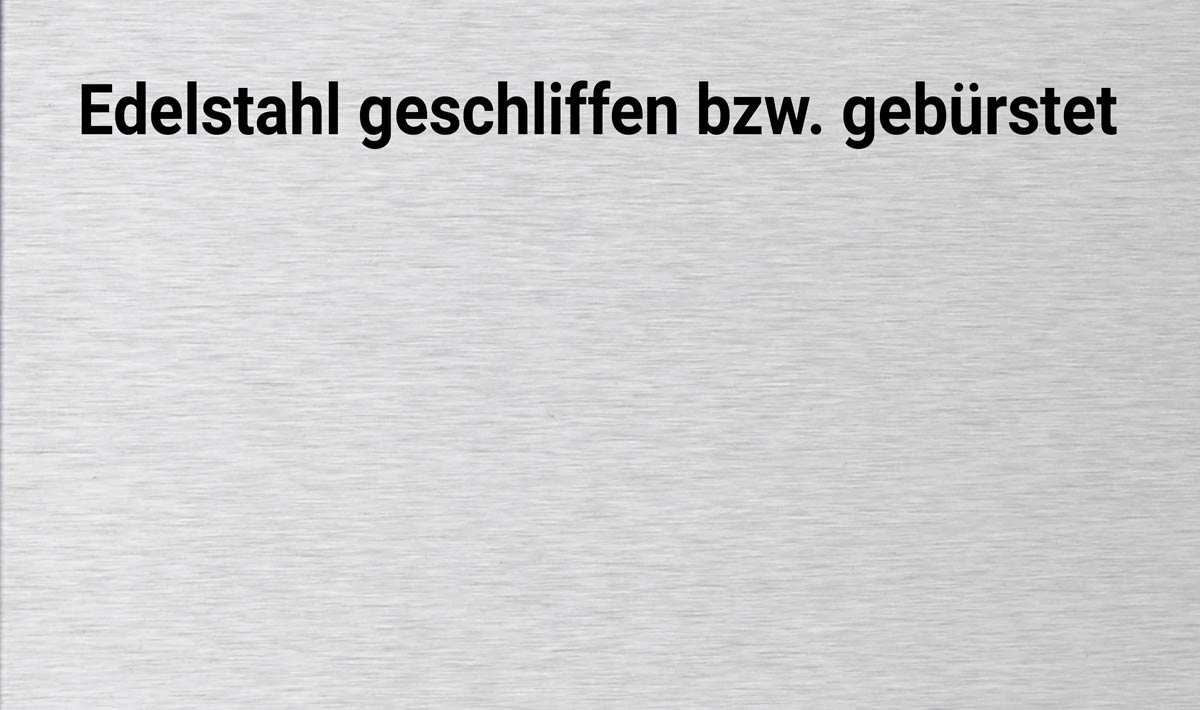
We use both terms interchangeably, so the abrasive rating of our products always corresponds to 240 grit. This number indicates the roughness/grain size of the abrasive. The surface is matt.
The mailbox manufactory - tradition since 2003
At Briefkasten Manufaktur, you can order your letterbox, free-standing letterbox or letterbox system with countless customisations directly in the shop! Briefkasten Manufaktur only uses systems, components and individual parts from well-known manufacturers in Germany. But our customer service doesn't end with your order: After your order, you may receive a design drawing by email as a PDF to realise your wishes down to the last detail. Your wishes will be considered in detail and even special requests that go beyond our configuration offer can be realised. After your production approval, your letterbox is customised and conveniently delivered by parcel post. Our customer service does not end here either, we ensure that the stainless steel letterboxes, letterbox systems, doorbells and lights are delivered to you in perfect condition with customised packaging.
And if you don't like a product you have purchased or something is not to your liking, you don't run any risk with us as a consumer. You can return our products within two weeks.
Letterboxes in over 80 colours
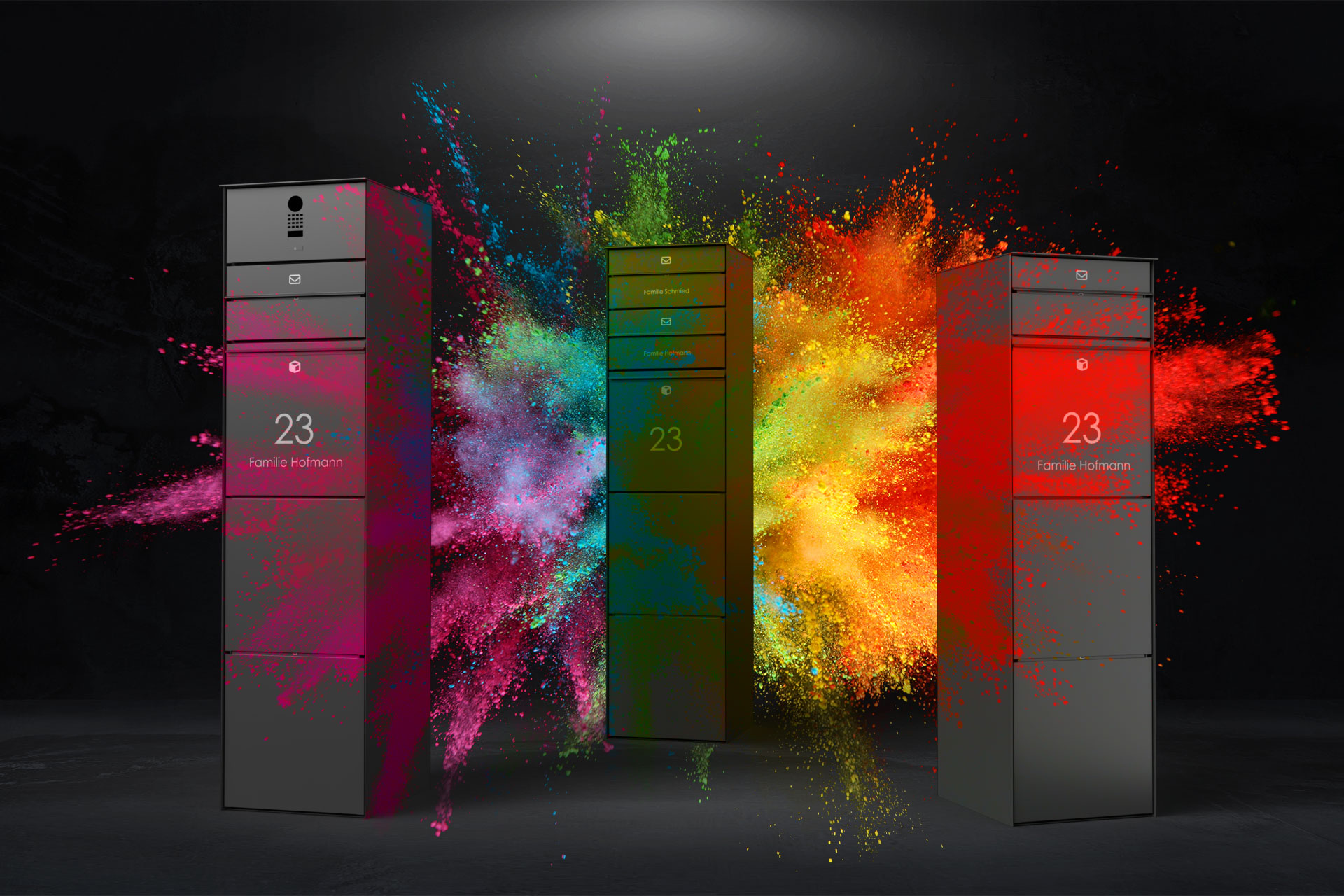
At Briefkasten Manufaktur, you can choose from over 80 colours or your desired RAL colour code. In addition to a wide range of colours, we also offer premium finishes for an even more attractive look.
Design letterboxes. Variability through customisation.
Every product at Briefkasten Manufaktur is customised and is only made by hand for you after you place your order. Many of our products can therefore be ordered directly in the shop with countless customisations. This is possible thanks to the modular structure, flexible prefabrication, warehousing and logistics. Individual components are already prefabricated so that very short delivery times can be achieved in some cases.
Simple installation thanks to well thought-out designs
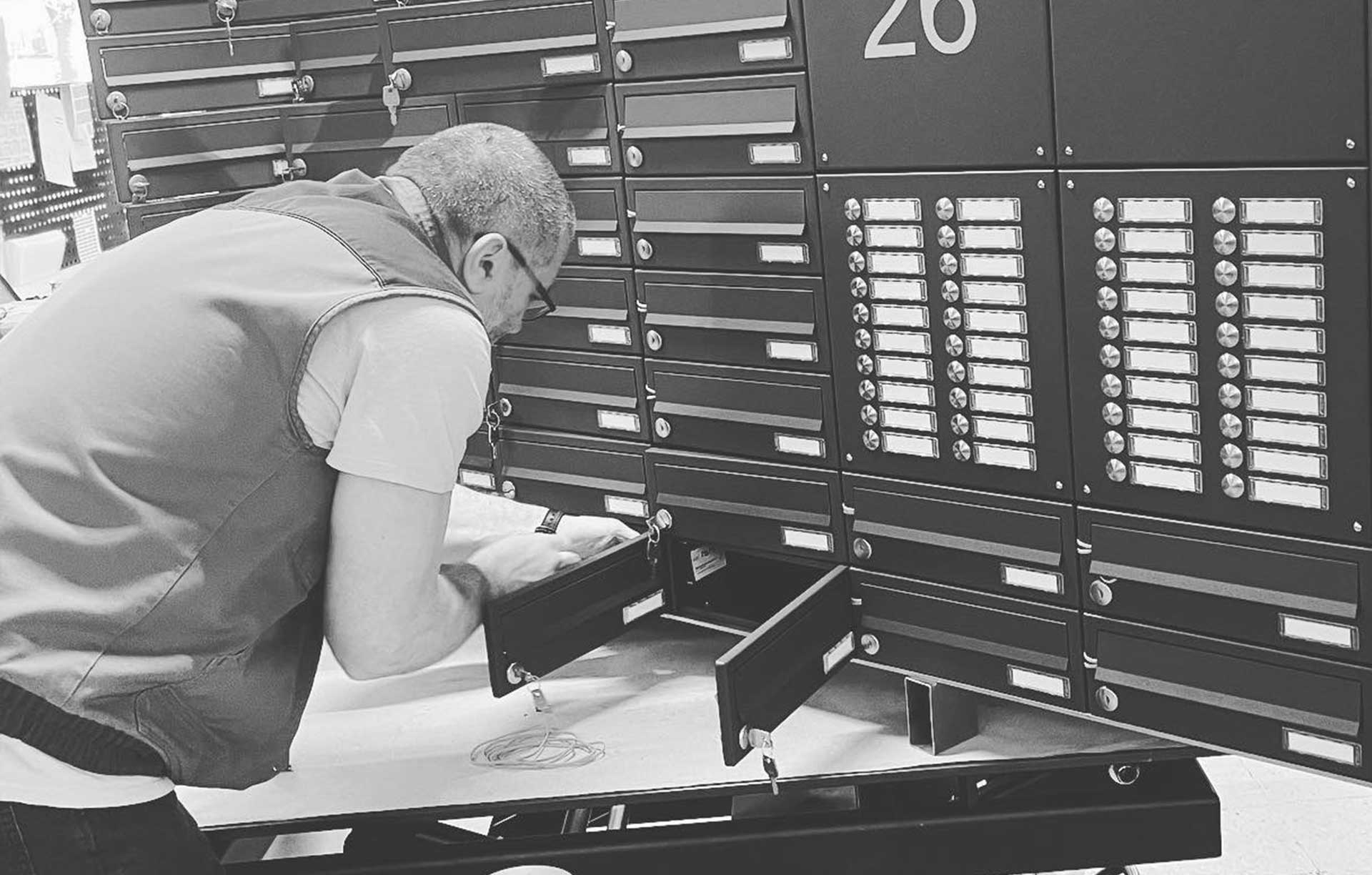
Our letterbox systems are supplied with detailed and easy-to-understand documentation and assembly aids and are usually fully assembled within a very short time.

.jpg)