



Which mailbox lock fits my mailbox?
Mailbox locks often look similar, but are not automatically interchangeable. For a suitable replacement lock you should first identify the mailbox series, model and existing lock type.
Briefkasten Manufaktur stocks replacement locks specifically for defined product series and models. This makes selection easier than with a universal part, where the lock mounting, cylinder, locking tongue or locking path may not match the existing mailbox.
Therefore check the product designation or article number of your mailbox if possible. If this is no longer known, photos of the complete mailbox as well as the front and back of the existing lock will help with identification.
Which mailbox lock do you need?
Depending on the mailbox and the desired operation, classic mechanical lever locks, special parcel locks, keyed-alike combinations or digital solutions may be appropriate.
| Lock type | Typical use | Special feature | Check before purchase |
|---|---|---|---|
| Lever lock / mailbox lock | Classic mailbox doors and retrieval flaps | Key is turned and moves a locking tongue | Series, lock mounting, locking tongue and direction of rotation |
| Parcel lock | Suitable parcel compartments and parcel mailboxes | Locking mechanism is tailored to the function of the parcel compartment | Parcel mailbox model and intended lock function |
| Keyed-alike lock | Multiple mail or parcel compartments intended for this purpose | Several locks can be operated with the same key | Availability of a suitable keyed-alike variant |
| Keyed-different lock | Compartments with separate access authorisations | Separate keyings with different keys | Number and desired allocation of the keyings |
| Digital mailbox lock | Mailboxes suitable for digital retrofitting | Opening without a traditional mechanical key | Series, lock mounting and technical compatibility |
| Push-Key lock | BML mailbox models designated for this | Insert key to unlock without turning it | Mailbox model, lock mounting and complete locking mechanism |
Choose a mailbox lock by series and model
Many BML replacement locks are assigned to specific mailbox series and models. The product designation is therefore often the most reliable starting point for selection.
| Lock series | Examples from the BML range | Note |
|---|---|---|
| BASIC Standard / KBxxx | including BASIC, 303, 380–385, 862–864, KANT, LESSING, KLEIST and other assigned models | Parcel compartments may require a different lock design |
| Series 2000 | including 325–326B, 515–515B, 553–554B, 592D and 599–599B | Observe the model assignment of the respective replacement lock |
| Series 6600 | for example 596 and 133 | Compare the existing version with the product information |
| PREMIUM | for example 205, 206 and 226–227 | Dedicated lock design for the respective product group |
| BASIC parcel locks | model-dependent solutions for suitable parcel compartments | Distinguish between T-handle as well as keyed-alike and keyed-different variants |
Order a replacement key or replace the mailbox lock?
A lost mailbox key does not automatically mean that the complete lock must be replaced. If the lock is technically sound and the keying is clearly known, a replacement key can be the simpler solution.
A replacement key is usually sufficient
If the existing lock works without problems and the key series or key number is known, a suitable replacement or additional key can be ordered.
Order replacement mailbox key →A new lock is advisable
If the lock is damaged, can no longer be operated reliably, or you deliberately want a new keying, a replacement lock that fits the mailbox is the better solution.
How can a lever lock be replaced on a mailbox?
In a classic lever lock the key moves a locking tongue that engages behind a stop. When replacing the lock, both the lock itself and the position and geometry of the locking tongue must therefore be taken into account.
Replace a lever lock in six steps
- Open the mailbox door: The normal replacement is carried out with the retrieval door open so that the lock and locking mechanism are accessible from the inside.
- Document the installation position: Photograph the position of the locking tongue and the order of the existing components before removing them.
- Release the fastenings: Depending on the lock version, a nut, retaining clip or securing device is released. Afterwards the old lock can be removed from the mounting.
- Insert the replacement lock: Fit the clearly matching lock into the existing lock mounting without tension and fasten it according to the intended construction.
- Align the locking tongue: The locking tongue must match the existing locking mechanism in terms of length, shape, angle and direction of rotation.
- Check the function: Operate the lock several times with the door open. Only when the lock and locking tongue move smoothly should the door be closed and the locking checked.
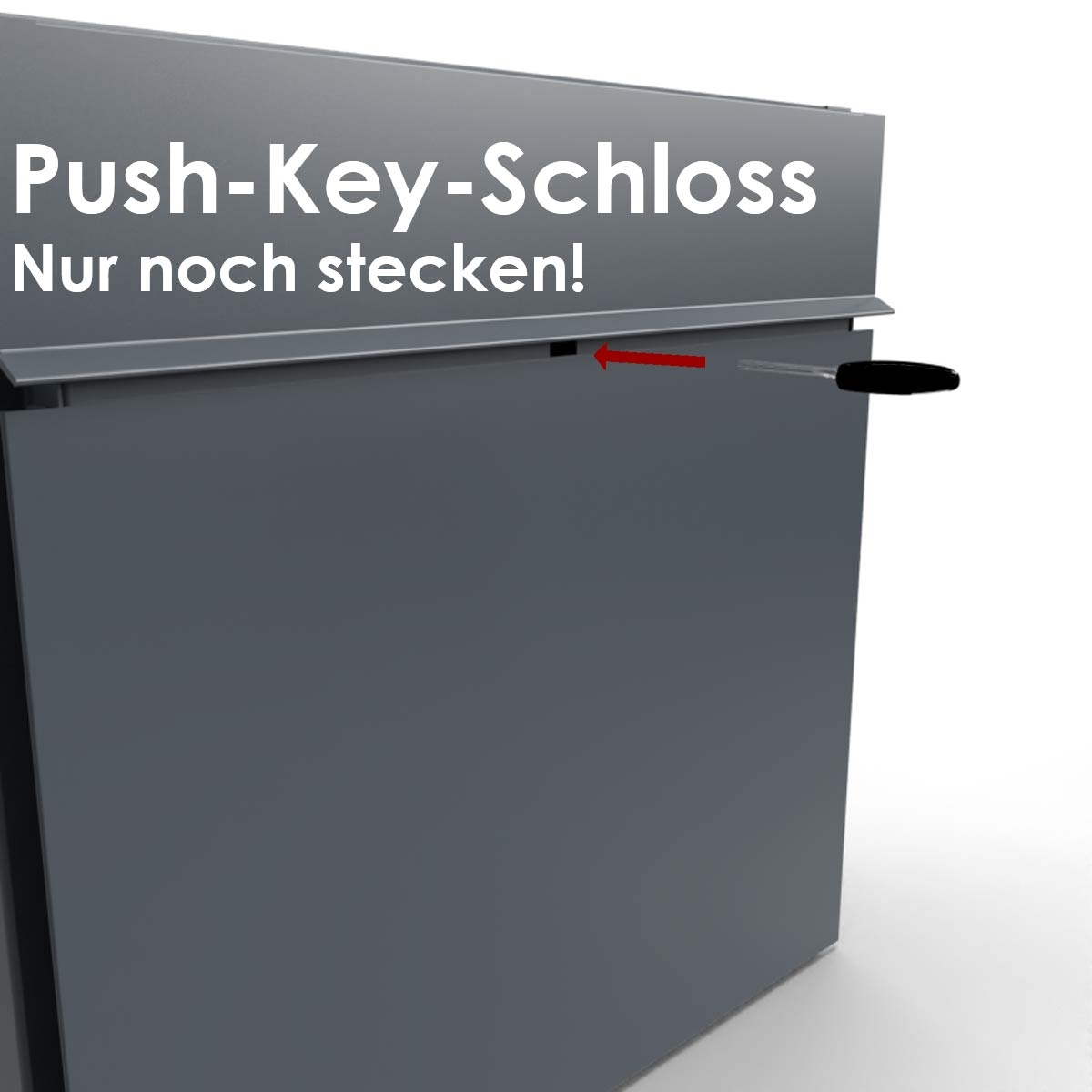
What distinguishes the Push-Key lock from the lever lock?
In a classic mailbox lock the key is turned, which moves a locking tongue. In the BML Push-Key lock, inserting the key is sufficient to unlock – a turning motion is not required.
Closing also follows a different principle: The designated mailbox flap is slid shut and locks mechanically.
This results in a simple operating logic. At the same time, the Push-Key system is not structurally equivalent to any arbitrary lever lock. When replacing, therefore lock, fastening and the existing locking mechanism must match the respective mailbox model.
How is a Push-Key lock replaced?
Replacing a Push-Key lock differs from the classic lever lock. The specific construction of the respective mailbox and the associated installation instructions are therefore decisive.
Replacing a Push-Key lock
- Open the retrieval flap: Open the mailbox normally so that the lock is accessible from the inside.
- Release the fastenings: For the intended BML construction, the fastening elements of the lock are released on the inside.
- Remove lock and cover: The lock and associated cover can then be carefully removed from their position.
- Insert a matching Push-Key lock: The new lock is fitted in the intended position or on the existing fastening points.
- Re-fit the cover: The lock and cover are reattached according to the intended construction.
- Check the locking: Then check with the flap open and closed whether unlocking and locking work reliably.
Lever lock or Push-Key lock – what is the difference?
| Feature | Lever lock | Push-Key |
|---|---|---|
| Opening | Insert key and turn | Insert key without a turning motion |
| Locking | via locking tongue or lever | system-dependent mechanical locking |
| Closing | depending on design via key movement | designated flap is slid shut |
| Important for replacement | Mounting, cylinder, locking tongue and direction of rotation | System compatibility, mounting and locking mechanism |
| Universally interchangeable? | No, dimensions and lever must match | No, only for constructions intended for it |
What does keyed alike mean for a mailbox lock?
With keyed-alike locks several designated cylinders can be operated with the same key. This can be practical, for example, for a combination of mailbox and parcel compartment.
Keyed alike
Several configured locks share the same keying. For example, a single key can be used for both the mailbox and a suitable parcel compartment.
Keyed different
The locks have different keyings. This variant is useful when individual compartments are to be operated separately from each other.
Fitting a digital mailbox lock
In addition to mechanical replacement locks, there are also digital solutions for suitable BML mailboxes that allow opening via an app.
Whether an existing mailbox can be retrofitted digitally depends on the series and the existing lock mounting. A digital lock should therefore be chosen by model in the same way as a mechanical replacement lock.
Before retrofitting, compatibility, lock mounting and the technical requirements belonging to the product should in particular be checked.
A defective lock does not mean the end of the mailbox
A mailbox lock is one of the components that may wear out or be replaced for other reasons during a long product life.
For suitable BML products, the lock can therefore be renewed specifically instead of replacing an otherwise functional mailbox completely.
The 10-year spare parts availability is part of our service concept for long-term use of Briefkasten Manufaktur products.
Frequently asked questions about mailbox locks
Are mailbox locks universally compatible?
No. Even mailbox locks that look similar can differ in lock mounting, cylinder length, fastening, locking tongue or direction of rotation. For BML mailboxes, the specific model or series assignment of the replacement lock should therefore be checked.
How do I find the right mailbox lock?
First check the series, model and, if possible, the article number of the mailbox. Photos of the front and back of the existing lock also help. For older systems, the approximate year of manufacture can also be helpful for identification.
How do you replace a lever lock on a mailbox?
With the mailbox door open, first document the position of the existing locking tongue. Then release the fastenings and remove the lock. The matching replacement lock is fitted into the existing mounting and the locking tongue is aligned with the locking mechanism. The function should be checked several times with the door open before closing it.
How is a Push-Key lock replaced?
For the Push-Key system the retrieval flap is first opened and the lock is made accessible from the inside. The lock and its fastening or cover are then released according to the existing construction. The matching replacement lock is mounted in the intended position. Finally, unlocking and locking must be checked carefully.
What is the difference between Push-Key and lever lock?
With the classic lever lock the key is turned and thereby moves the locking tongue. With the purely mechanical BML Push-Key system the key only needs to be inserted to unlock. A turning motion is not required.
Lost mailbox key – do I immediately need a new lock?
Not necessarily. If the lock is technically sound and the key series or key number is known, a replacement key can often be ordered. If the lock is damaged or the previous keying should no longer be used, a new lock is more sensible.
What does keyed alike mean for a mailbox lock?
Keyed alike means that several designated locks can be operated with the same key. This can be convenient, for example for a mailbox and a parcel compartment.
What does keyed different mean?
Keyed-different locks have separate keyings. Each lock is operated with a different key.
Why does the mailbox jam after a lock replacement?
A possible cause is an incorrectly aligned locking tongue or an installation under tension. The lock should sit without tension and the locking mechanism should engage cleanly behind the intended stop.
Can a digital mailbox lock be retrofitted?
For suitable BML mailboxes digital retrofitting is possible. Whether the specific lock fits must be checked based on series, lock mounting and product information.
How long are BML mailbox locks available as spare parts?
Briefkasten Manufaktur offers spare parts availability for 10 years. The concrete availability of a specific lock still depends on series and product version. For older mailboxes it is therefore advisable to check before ordering.
What can I do if I cannot identify my lock?
Send us the product or article number of your mailbox if possible, as well as photos of the mailbox and the existing lock from the outside and inside. This often allows the appropriate lock series to be determined precisely.
We will help you select the right replacement lock
Send us the designation of your mailbox and, if possible, the article number and photos of the mailbox, lock front and lock back. This allows us to check precisely which mailbox lock fits your BML product.
