


Mailbox standard explained
DIN EN 13724: Requirements for mailboxes
DIN EN 13724 describes requirements and test procedures for insertion openings of domestic mailboxes and letter slots. The focus is on unfolded C4 items, appropriate insertion dimensions, protection against weather and unauthorised removal, as well as safe, ergonomic operation.
Short answer
What does DIN EN 13724 mean for a mailbox?
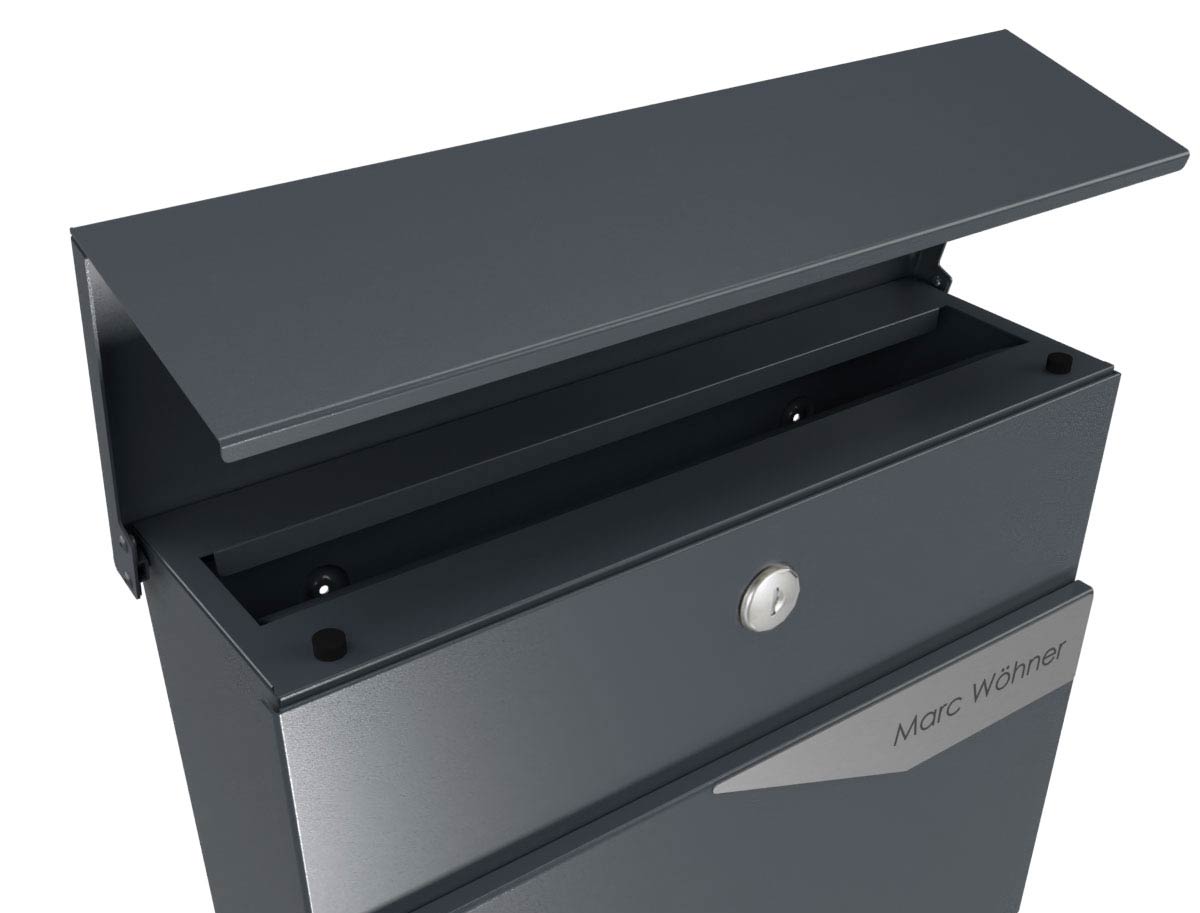
A mailbox conforming to DIN EN 13724 should reliably receive, protect and release typical postal items without damage. For this purpose the standard considers not only the width of the insertion slot. It also includes test items, opening types, ergonomics, protection against injury, confidentiality, corrosion resistance, water penetration, protection against unauthorised removal, locks and installation information.
The standard is aimed at manufacturers, planners and specialists. For product selection it is particularly important that insertion opening, interior space, retrieval door and installation position function together as a complete system.
Status July 2026
Which mailbox standard currently applies?
DIN Media continues to list DIN EN 13724:2013-07 as the current edition. Additionally, DIN EN 13724 Amendment 1:2016-08 applies. The 2013 edition replaced DIN EN 13724:2003-05; the earlier German DIN 32617 is therefore no longer part of the current standards status.
Compared with the previous edition, among other things a third insertion size, additional test items, a security level 0, requirements for the installation height of locks and extended protection for insertion openings in doors and door side panels were added.
Is the standard automatically law?
No. DIN standards are generally voluntary technical rules. They can become binding if laws or regulations refer to them or if they are agreed in contracts, specifications and tenders.
Even without explicit agreement, standards can play an important role when assessing the recognised rules of technology and possible defects.
Important: This guide summarises practice-relevant points in an understandable way. For tenders, declarations of conformity or technical evidence the complete, current standard text including amendment is authoritative.
Classification
Which four types of insertion openings does the standard distinguish?
External mailbox
Insertion openings of domestic mailboxes for outdoor use, for example in wall-mounted mailboxes, freestanding systems and mailbox columns.
Internal mailbox
Insertion openings of domestic mailboxes that are used exclusively in protected indoor areas.
Pass-through mailbox
Insertion on the delivery side and retrieval on the opposite side, for example in through-wall or fence solutions.
Letter plate
Insertion openings or letter plates in doors or door side panels. Special requirements apply here to prevent possible access through the opening.
Insertion slot and test items
What dimensions does DIN EN 13724 require for the insertion?
The standard recognises three insertion sizes. Therefore the shortened statement “a DIN mailbox needs at least 230 mm slot width” is not precise enough. Decisive are the intended insertion size, the opening type and the corresponding test.
| Insertion size | Clear width | Clear height | Practical relevance |
|---|---|---|---|
| Size 1 | 325–400 mm | 30–35 mm | Wide opening for insertion of a C4 item along the long edge |
| Size 2 | 230–280 mm | 30–35 mm | Narrower opening for a different insertion orientation of the test item |
| Size 3 | 325–400 mm | 35–45 mm | Greater insertion height for thicker test items; not for opening type 4 |
Why is the C4 format decisive?
A C4 envelope measures 229 × 324 mm and holds unfolded A4 documents. The flexible test item specified by the standard is 24 mm thick. It must fit through the opening and be retrievable from a domestic mailbox without being folded or damaged.
For insertion size 3 additional rigid test bodies are considered, including a test item of 229 × 324 × 34.5 mm. A higher insertion slot can therefore be useful for thicker items.
The clear opening alone is not sufficient. Flap mechanics, retrieval security, box depth, usable volume and the retrieval opening must not block the item.
- Check width and height of the free opening
- Consider flap travel and damping
- Account for internal components
- Ensure retrieval without folding
More than minimum dimensions
What other requirements does the mailbox standard set?
Corrosion and water
The corrosion resistance of the insertion components is classified according to EN 1670. Exterior, pass-through and door openings must therefore achieve appropriate corrosion classes. In addition, posted mail must not be affected by the defined water test when openings are closed.
Retrieval security
Construction, distance between insertion and accumulated mail and, where applicable, a retrieval guard should make access from outside more difficult. The standard distinguishes security levels 0, 1 and 2 and contains tests for housing and lock.
Safety and ergonomics
Reachable components must not have sharp edges. The insertion flap must close automatically; the force required for full opening must not exceed 8 N according to the standard.
Confidentiality
Domestic mailboxes should be designed without a visible viewing window. If a window is provided, it must be obscuring or translucent so that item contents are not openly visible.
Installation instructions
Appropriate fastening and installation information must be provided with the product. Norm-compliant function requires the mailbox to be installed according to the manufacturer's instructions.
Material and location
Stainless steel, galvanised steel and high-quality powder coatings support a durable implementation. Material quality, however, does not replace a suitable location: driving rain, splashing water and lack of shelter should already be considered during planning.
Ergonomic installation
At what height should a mailbox be installed?
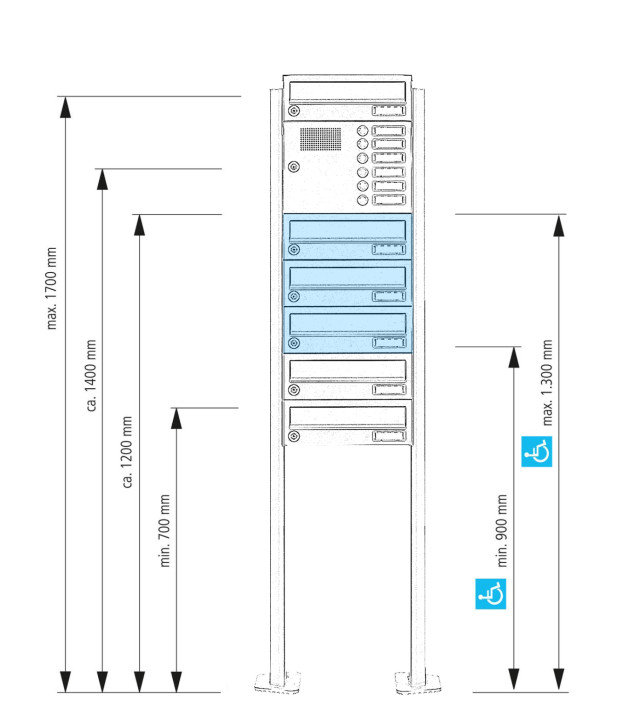
Insertion opening: 700 to 1,700 mm as guidance
The often-cited insertion height of 700 to 1,700 mm comes from informative Annex B of DIN EN 13724. It serves as an ergonomic planning corridor for countries without differing national provisions. It is not a blanket legal mounting obligation for every mailbox in Germany.
For systems with multiple boxes the arrangement should be chosen so that delivery personnel and users can safely reach the insertion flaps. Very low or very high compartments should be checked early, especially in large grids.
Lock axis: separate requirement
For individual domestic mailboxes of types 1 to 3 the lock axis must be between 900 and 1,300 mm. In group systems at least 30% of the lock axes should be arranged within this range.
Accessible design goes beyond these values. Depending on the building type, among other things building regulations, DIN 18040, manoeuvring spaces, lateral approachability, operating forces and project-specific requirements must be considered separately.
Do not confuse: insertion height, lock axis, doorbell button, display, intercom and parcel compartment are different control elements. In combined systems their heights must be planned together.
Application in the building
DIN EN 13724 for single-family houses, apartment buildings and commercial properties
Single-family house
Crucial are a C4-capable insertion, sufficient volume and a protected, easily reachable location. Depending on the architecture, wall-mounted mailboxes, flush-mounted models, freestanding columns or pass-through solutions may be suitable.
Apartment building
In addition to individual boxes, grids, operating heights, labelling, locking and maintenance access matter. A centrally planned mailbox system facilitates a uniform design and clear allocation.
Commercial and project construction
Here tenders, user groups, mail volumes, access control, fire protection, accessibility and, if applicable, door communication are added. The standard reference and desired security level should be specified clearly in the specification.
- Define opening type and insertion size
- Determine mail volume and required capacity
- Consider delivery and retrieval side
- Check mounting height and manoeuvring spaces
- Assess driving rain and splashing water
- Plan doorbell, intercom and access
Which mounting type is suitable?
Flush-mounted mailboxes integrate flush with the façade. Through-wall mailboxes separate insertion and retrieval spatially. Freestanding post-mounted mailboxes are suitable when the delivery point should be closer to the property boundary or driveway.
The mounting type does not change the fundamental requirements for insertion, protection and usability, but it affects housing, cladding, foundation, weather protection and cable routing.
Mail reception 2026
Is a mailbox according to DIN EN 13724 sufficient for goods and parcels?
DIN EN 13724 is aimed at postal items and defined test items. It does not automatically make a domestic mailbox a parcel mailbox. Thicker goods mail, padded envelopes and parcels can exceed the insertion opening or the usable volume.
Additionally, DIN CEN/TS 17523:2021-01 exists as a pre-standard for packaging of small and light mailbox-capable goods. It considers the packaging side and does not replace the requirements of DIN EN 13724 for the mailbox.
Typical planning mistakes
What do good mailbox plans often fail on?
Considering only the slot width
A C4 envelope can get stuck despite a wide opening due to the flap, retrieval guard or too small internal space.
Checking mounting height too late
Large systems cannot be stacked arbitrarily. Insertion, lock, doorbell and door communication each require reachable positions.
Underestimating weather
Even corrosion-resistant materials require correct installation. Open flaps, driving rain and splashing water affect mail protection.
Assuring “DIN” across the board
Conformity to a standard relates to defined properties and tests. Product, installation and installation situation must be assessed together.
Underestimating mail volume
Catalogues, magazines and multi-day absences significantly increase the required volume. A pure minimum solution can quickly become overfilled in everyday life.
Mixing up parcel reception
A standards-oriented mailbox is not automatically a secure parcel box. For parcels volume, locking and delivery process must be defined separately.
Selection by mounting type
Suitable mailbox solutions for standards-oriented planning
The specific suitability depends on design, insertion size, mounting and project requirements. The following examples show different solutions for wall, façade, property and technically integrated entrance areas.
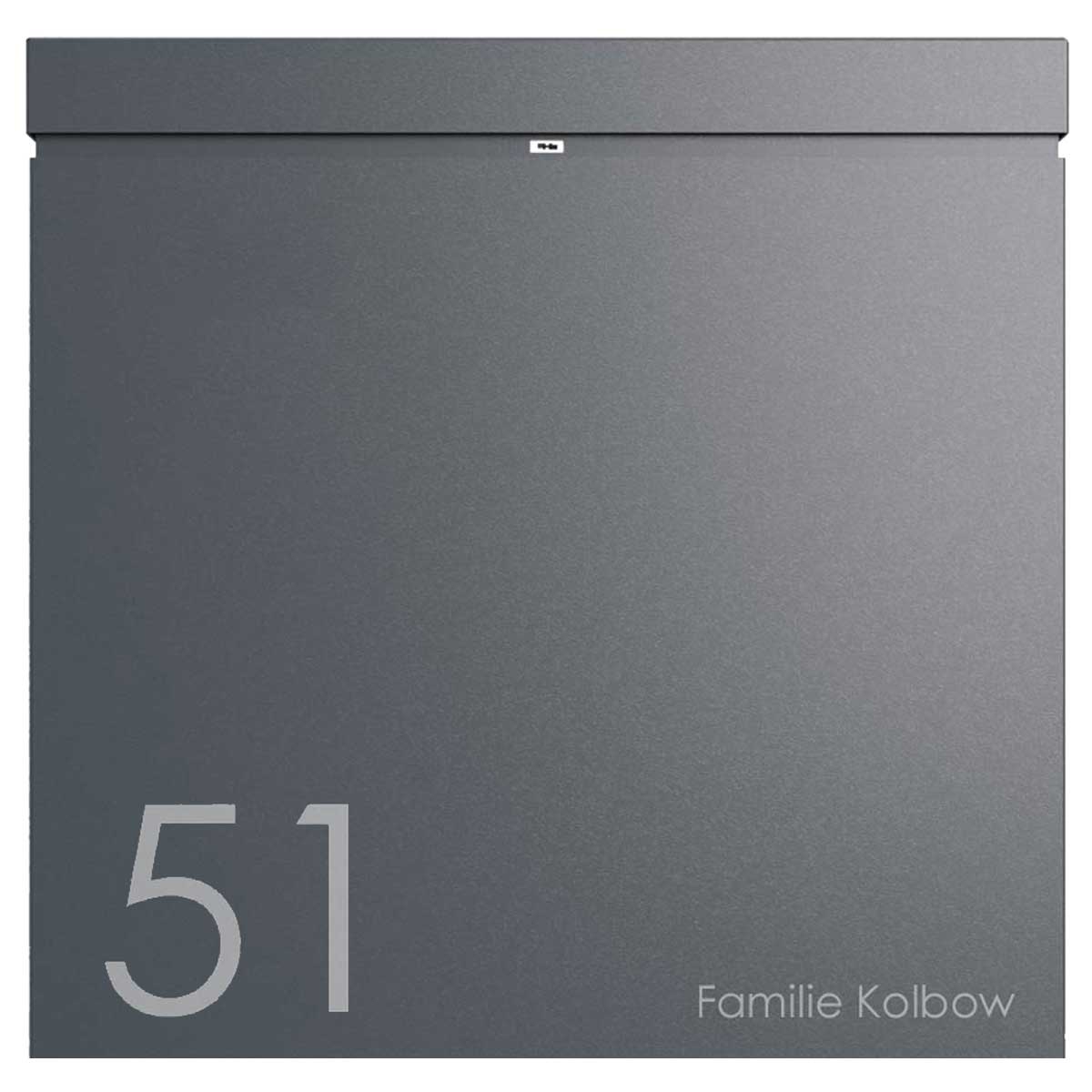
BRENTANO wall-mounted mailbox
Surface-mounted solution for single-family houses with a clear design language and durable powder coating.
View product →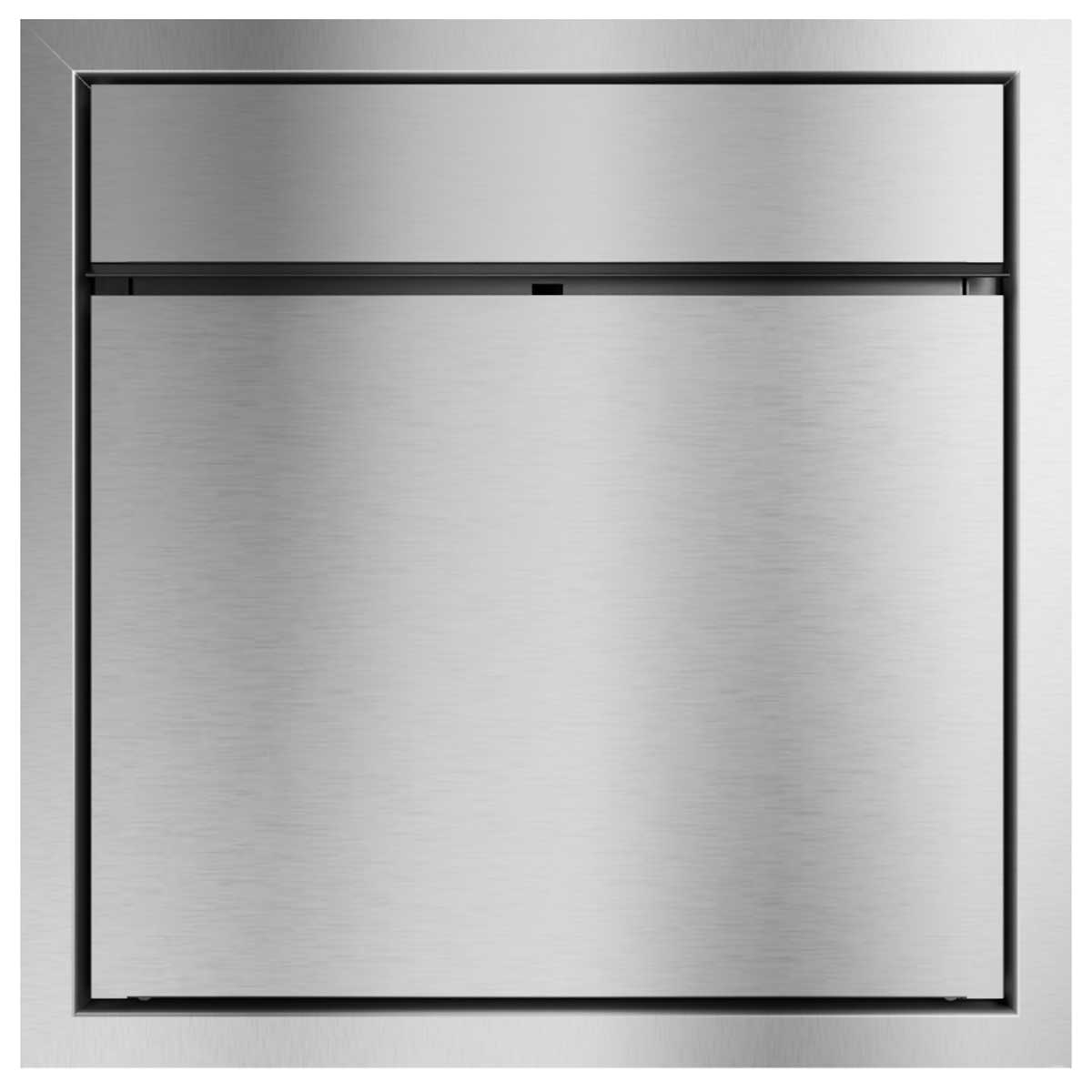
GOETHE flush-mounted mailbox
Flush-mounted façade solution made of brushed stainless steel V2A for high-quality entrance areas.
View product →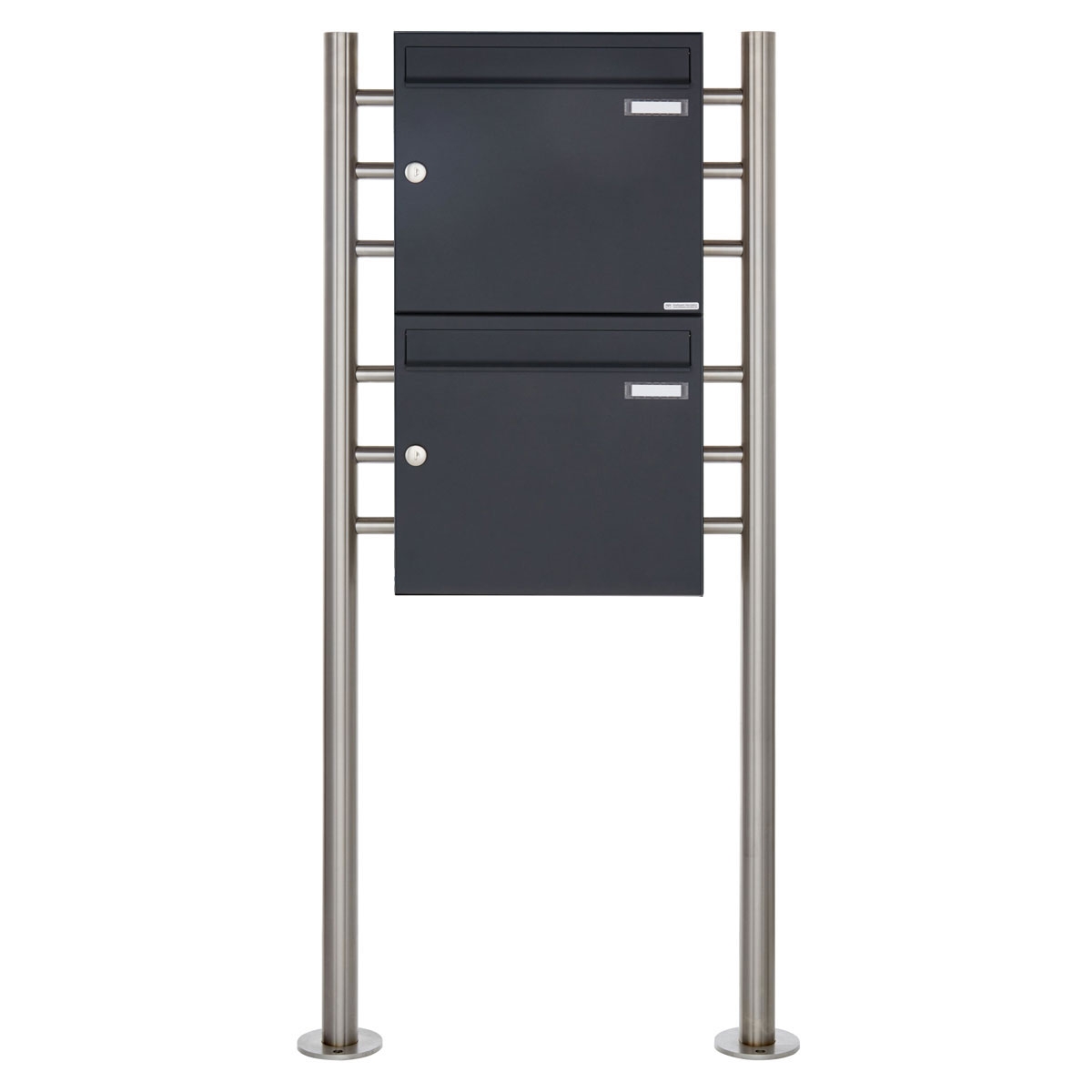
BASIC mailbox system
Freestanding system for two households with post and clearly separated insertion and retrieval compartments.
View product →
STORM with DoorBird
Surface-mounted mailbox with integrated IP video door intercom for a technically coordinated entrance.
View product →Frequently asked questions
FAQ on DIN EN 13724 and mailbox planning
Which standard currently applies to domestic mailboxes?
The current applicable documents are DIN EN 13724:2013-07 together with DIN EN 13724 Amendment 1:2016-08. DIN Media continues to list both documents as current.
What dimensions must an insertion slot have?
The standard distinguishes three insertion sizes: 325–400 × 30–35 mm, 230–280 × 30–35 mm and 325–400 × 35–45 mm. The appropriate size depends on opening type, insertion orientation and testing.
Must a C4 envelope fit into the mailbox without folding?
Yes. The defined flexible C4 test item measuring 229 × 324 × 24 mm must be able to be inserted and retrieved from domestic mailboxes without folding or damage.
Is a slot width of 230 mm always standard-compliant?
No. 230–280 mm belongs to a specific insertion size and insertion orientation. For insertion along the long edge of the C4 item a clear width of at least 325 mm is required.
What mounting height applies to mailboxes?
The commonly cited range of 700 to 1,700 mm is an ergonomic guidance from informative Annex B. The lock axis for individual domestic mailboxes of types 1 to 3 must be between 900 and 1,300 mm. National and project-specific provisions should be checked in addition.
Is DIN EN 13724 legally binding?
DIN standards are generally voluntary. They can become binding through laws, regulations, contracts or tenders. They can also be relevant when assessing recognised rules of technology.
Does the standard also regulate weather protection and retrieval security?
Yes. The standard contains requirements and tests for corrosion, water penetration, housing, lock and protection against unauthorised removal. Correct installation according to the manufacturer's instructions is part of the assessment.
Is a DIN-compliant mailbox automatically accessible?
No. DIN EN 13724 considers ergonomics but does not replace comprehensive accessible design. Depending on the building, among other things building regulations, DIN 18040, manoeuvring spaces and additional control elements must be considered separately.
Does DIN EN 13724 also apply to parcel mailboxes?
The standard deals with insertion openings for postal items and defined test items. A parcel compartment requires additional specifications on dimensions, delivery process, locking and retrieval protection.
What must be considered for a mailbox system for multiple households?
In addition to appropriate insertion and box dimensions, grids, lock and insertion heights, clear labelling, weather protection, maintenance access and possibly doorbell or intercom systems must be planned together.
Standards-oriented and project-specific
Plan a mailbox system suited to the building
Choose mounting type, mailbox format, RAL colour and desired functions suited to the façade, number of users and actual mail volume. For apartment buildings, commercial properties and bespoke solutions we support you with technical coordination.
Technical information status: 28 July 2026. This article does not replace a review of the complete standard text or project-specific specialist planning.
